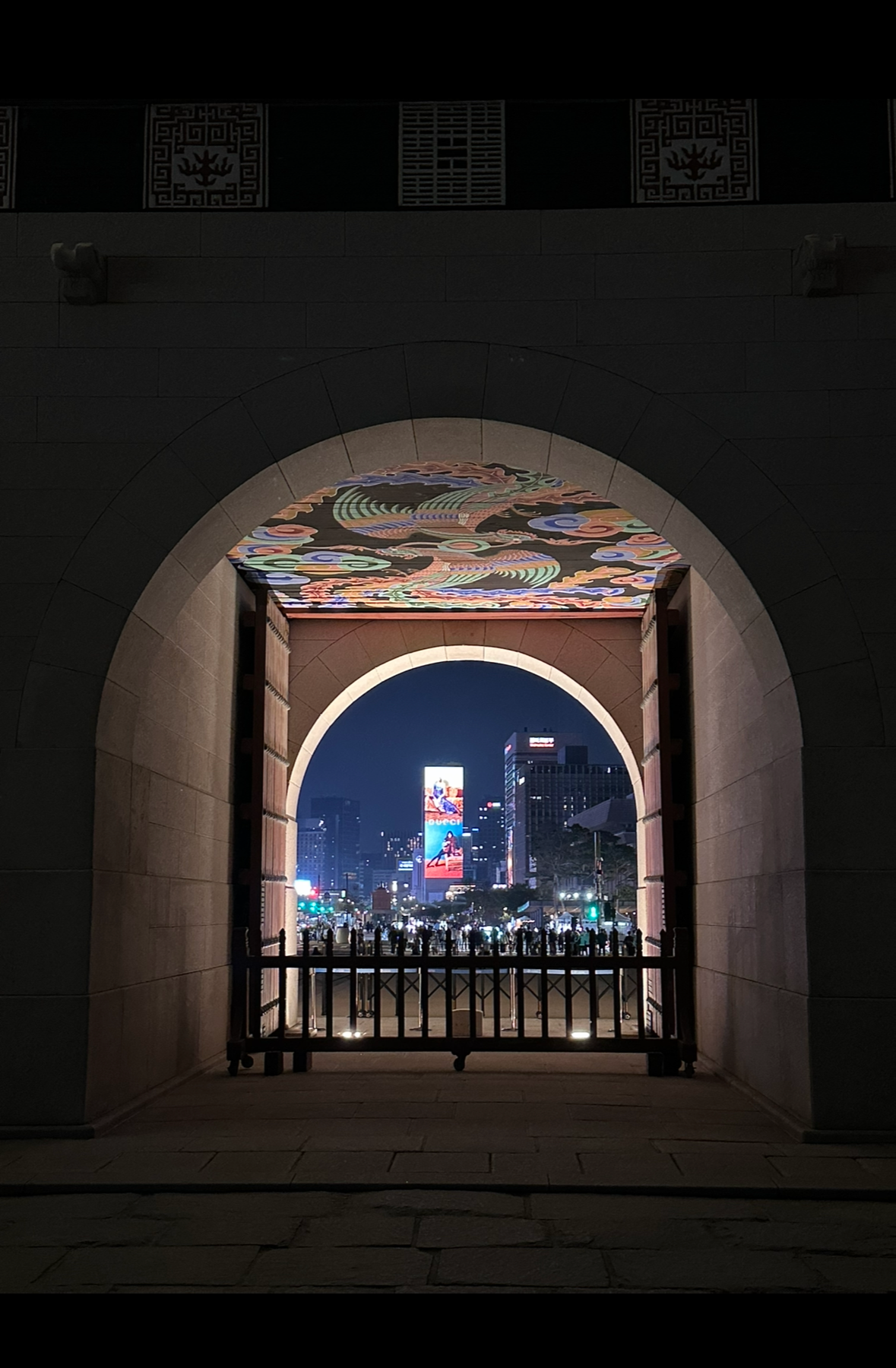
Through Gwanghwamun Gate: Where Joseon Meets Modern Seoul at Night
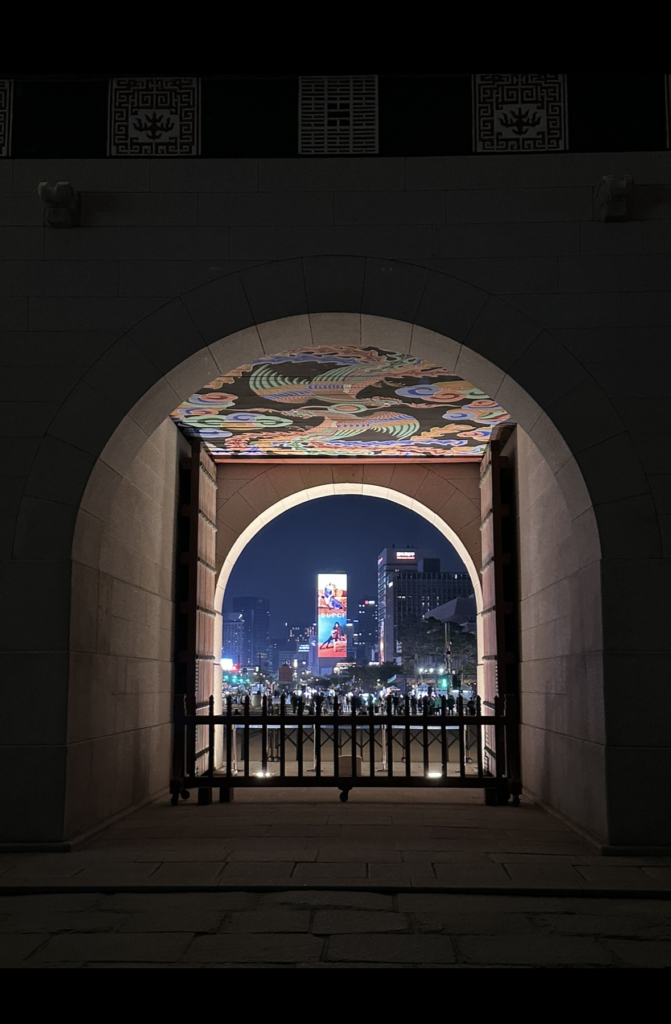
Almost every evening, I take a walk around Gwanghwamun Square. It’s been my neighborhood for eight years, and there’s one view I never get tired of. It isn’t a famous pavilion or a postcard shot of the throne hall. It’s this: standing inside Gyeongbokgung Palace at night, looking back out through the arch of Gwanghwamun Gate.
Above you, a vermilion bird spreads its wings across the painted ceiling of the gate. Beyond it, framed by stone, the lights of modern Seoul glow over Gwanghwamun Square. In a single frame, you’re looking from the Joseon Dynasty straight into the 21st century.
In this post, I’ll tell you what you’re looking at, when you can see it for yourself, and how to make the most of an evening around the palace.
(You can read more about me here.)
What You’re Looking At
Gwanghwamun is the main south gate of Gyeongbokgung, the first and largest royal palace of the Joseon Dynasty, built in 1395. Its name roughly means “may the light of the king’s virtue spread across the land.” Of its three arched passages, the wide one in the middle was reserved for the king.
The Bird on the Ceiling
Look up when you pass through the central arch. The painting is Jujak, the vermilion bird, guardian of the south in East Asian cosmology. Gyeongbokgung’s gates follow this system: each one is protected by the guardian of its direction. Next time you walk around the palace walls, check the ceilings of the other gates too.
A Gate That Survived History
The gate you see today has had a turbulent life. It burned during the Japanese invasions of the 1590s and was rebuilt in the 1860s. During the Japanese colonial period it was moved away from the palace’s central axis, and it was badly damaged in the Korean War. In 2010, it was finally restored to its original position in wood and stone, and in 2023 the raised royal terrace in front of it was restored as well.
The Building That Once Hid the Palace
The spot where I took this photo has a darker story. During the Japanese occupation, the colonial government tore down palace buildings right here and, in 1926, completed the massive Japanese Government-General Building directly in front of the throne hall. Gwanghwamun itself was moved aside to make way for it. For about seventy years, that building stood between the city and the palace. When I was a child, you couldn’t see Gyeongbokgung from the street at all, only the colonial building. It was finally demolished in 1996, and the gates and courtyards behind it have been restored step by step ever since.
Why This View Matters to Me
That’s why the view through the arch moves me. I’m standing where a colonial building once stood, one that hid this palace for most of the 20th century, including my own childhood. Now the gate is back where it belongs, and through it you see what Korea has become: glowing office towers, a lively public square, and people out enjoying the evening. To me, Gwanghwamun is the point where the past and present of Seoul pass through each other.
When to See Gyeongbokgung at Night
Night Viewing: Twice a Year
Gyeongbokgung opens at night for a limited season twice a year, usually in spring (around May–June) and autumn (around September–October). In 2026, the spring season ran from May 13 to June 14 and the autumn season from September 2 to October 2. Tickets sell out fast, so check the dates as soon as they’re announced.
| Night viewing | Daytime | |
|---|---|---|
| Hours | 19:00–21:30 (last entry 20:30) | Nov–Feb 9:00–17:00 Mar–May, Sep–Oct 9:00–18:00 Jun–Aug 9:00–18:30 (last entry 1 hour before closing) |
| Closed | Mondays and Tuesdays | Tuesdays |
| Ticket | 3,000 KRW (ages 7–64) | 3,000 KRW |
| Free entry | Hanbok wearers, under 7, 65+ | Same |
| Booking | Online in advance; 300 on-site tickets a day for foreigners (max 2 each) | No booking needed |
Tips for Getting In
- Foreign visitors have an advantage. A limited number of on-site tickets are set aside each night for foreigners. Bring your passport and arrive early.
- Wear hanbok and get in free. Hanbok wearers enter free, even at night, but the outfit has to follow the palace’s official guidelines. Very short skirts, fusion styles, and costume-like outfits may be refused.
- Can’t make the night season? You can still see this view during the day. Walk through Gwanghwamun into the palace, then turn around before you reach the next gate. With blue sky behind the arch, it’s a completely different picture.
Make an Evening of It
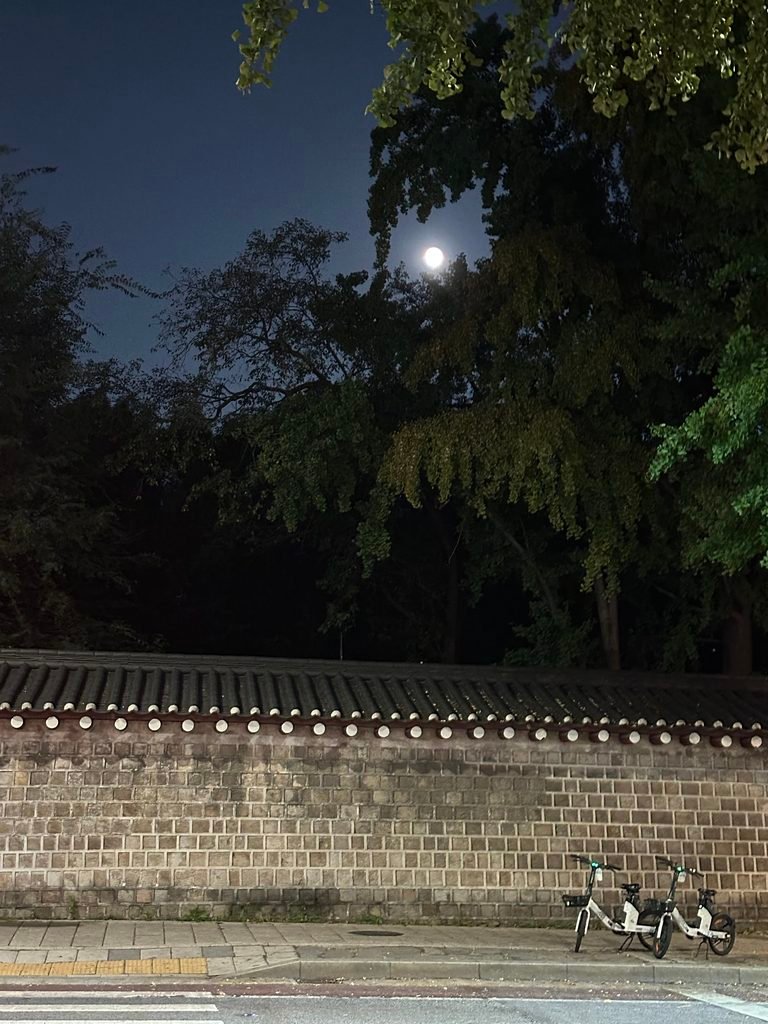
When you leave the palace, don’t head straight for the subway. Walk along the palace’s old stone wall instead. On the evening I took this photo, a full moon was rising over the ginkgo trees, and the tiled roof of the wall glowed under the streetlights. In late autumn, those same ginkgo leaves turn bright yellow and cover the sidewalk.
Three Tips From a Local
- Go on a weekday. Weekends are packed with tourists and locals in hanbok. On a weekday evening you’ll have far more space to stand in the arch and take your time.
- Catch the Royal Guard Changing Ceremony. If you’re here during the day, the ceremony takes place in front of Gwanghwamun at 10:00 and 14:00 (except Tuesdays). It’s free and takes about 20 minutes.
- End with food and a drink. The old neighborhood of Seochon, just west of the palace, is full of small restaurants and bars. After a long walk, a Korean meal and a bowl of makgeolli is the perfect way to finish the night.
Getting There
Take Seoul Subway Line 3 to Gyeongbokgung Station (Exit 5), or Line 5 to Gwanghwamun Station (Exit 2) and walk through Gwanghwamun Square to the gate.